
Cryptocurrency Prices by Coinlib
What Is Crypto Staking? How It Works & What You Earn

There are two principal methods your crypto can earn whilst you maintain it
Most individuals know you should purchase crypto and wait. Fewer know your crypto can work whilst you wait.
Two of the most typical methods to earn in your holdings are crypto staking and incomes curiosity. They appear comparable at first — each generate returns on crypto you already personal — however they work very otherwise. Understanding the distinction helps you make a extra knowledgeable selection about what to do along with your belongings.
This information focuses on staking: what it's, the way it works, what the dangers are, and the way it compares to incomes curiosity by way of a platform like Nexo.
What's crypto staking?
Staking is the method of locking up your crypto to assist run a blockchain community — and receiving rewards in return.
To know why this exists, it helps to know just a little about how blockchains work.
Older blockchains like Bitcoin depend on proof of labor to validate transactions. On this system, miners compete to unravel complicated computational puzzles. It requires important {hardware} and vitality.
Newer blockchains — together with Ethereum (since its 2022 improve), Solana, Cardano, and others — use proof of stake as a substitute. On this system, validators do not mine. As an alternative, they lock up, or stake, a certain quantity of the community's personal cryptocurrency as collateral. By doing so, they sign that they've a monetary curiosity within the community working appropriately. In return for validating transactions truthfully and protecting the community operating, they earn staking rewards.
Consider it like a safety deposit. You commit your crypto, the community trusts you as a validator as a result of you have got one thing to lose when you misbehave, and also you receives a commission on your participation.
How do staking rewards work?
Whenever you stake, the rewards you earn come from the blockchain itself — usually paid out in the identical cryptocurrency you staked.
How a lot you earn is determined by a number of elements:
The community's reward price — every blockchain units its personal annual staking yield, which fluctuates primarily based on what number of validators are lively and the way a lot crypto is staked in complete
How a lot you stake — rewards are proportional to your stake
Lock-up durations — some networks pay larger charges when you decide to longer lock-up home windows
Staking returns are normally expressed as an APY (Annual Proportion Yield). Typical ranges differ extensively — from below 2% on some networks to over 15% on others — although charges change continuously, and the upper the yield, the extra threat is normally concerned.
Three kinds of staking: direct, pooled, and liquid
You do not all the time must run your individual validator node to stake. There are three principal methods to take part.
Direct (solo) staking
You validate transactions your self. This requires important technical data and, in Ethereum's case, a minimal of 32 ETH. It is essentially the most decentralized type of staking however the least accessible for most individuals.
Pooled staking
A number of holders mix their crypto to satisfy the minimal staking requirement or improve their share of rewards. The pool's validator does the technical work; you share within the rewards proportionally. Staking swimming pools on centralized exchanges and DeFi protocols each work this manner.
Liquid staking
Whenever you stake by way of a liquid staking protocol (like Lido for Ethereum), you obtain a tokenized receipt — for instance, stETH — representing your staked place. This token can be utilized elsewhere in DeFi whereas your underlying crypto continues to be incomes staking rewards. You retain liquidity, however you tackle the added threat of the liquid staking protocol itself.
The dangers of staking that almost all guides skip over
Staking rewards exist as a result of staking entails actual commitments and actual dangers. Listed here are those price understanding earlier than you begin.
Lock-up durations. Many networks require you to lock your crypto for days, weeks, or longer. Throughout this time, if the market drops sharply, you'll be able to't promote or transfer your belongings. Unstaking usually entails a ready interval — Ethereum's unbonding interval, for instance, can take a number of days relying on community situations.
Slashing. Validators who behave incorrectly — whether or not as a result of malicious intent or technical failure — can have a portion of their staked crypto destroyed. That is known as slashing. In pooled or liquid staking, you share publicity to this threat even when you're not operating the validator your self.
Good contract threat. Liquid staking and pooled staking by way of DeFi protocols depend on sensible contracts. If a contract has a bug or is exploited, stakers can lose funds. That is separate from the blockchain itself failing.
Reward price volatility. Staking APYs will not be fastened. They transfer primarily based on the variety of lively validators and community demand. A ten% APY at this time can grow to be 4% six months from now.
Tax remedy. In lots of jurisdictions, staking rewards are thought-about taxable earnings on the time they're obtained — not simply once you promote. The foundations differ by nation, so consulting a certified tax adviser earlier than staking important quantities is a smart step.
Staking vs. incomes curiosity: how they evaluate
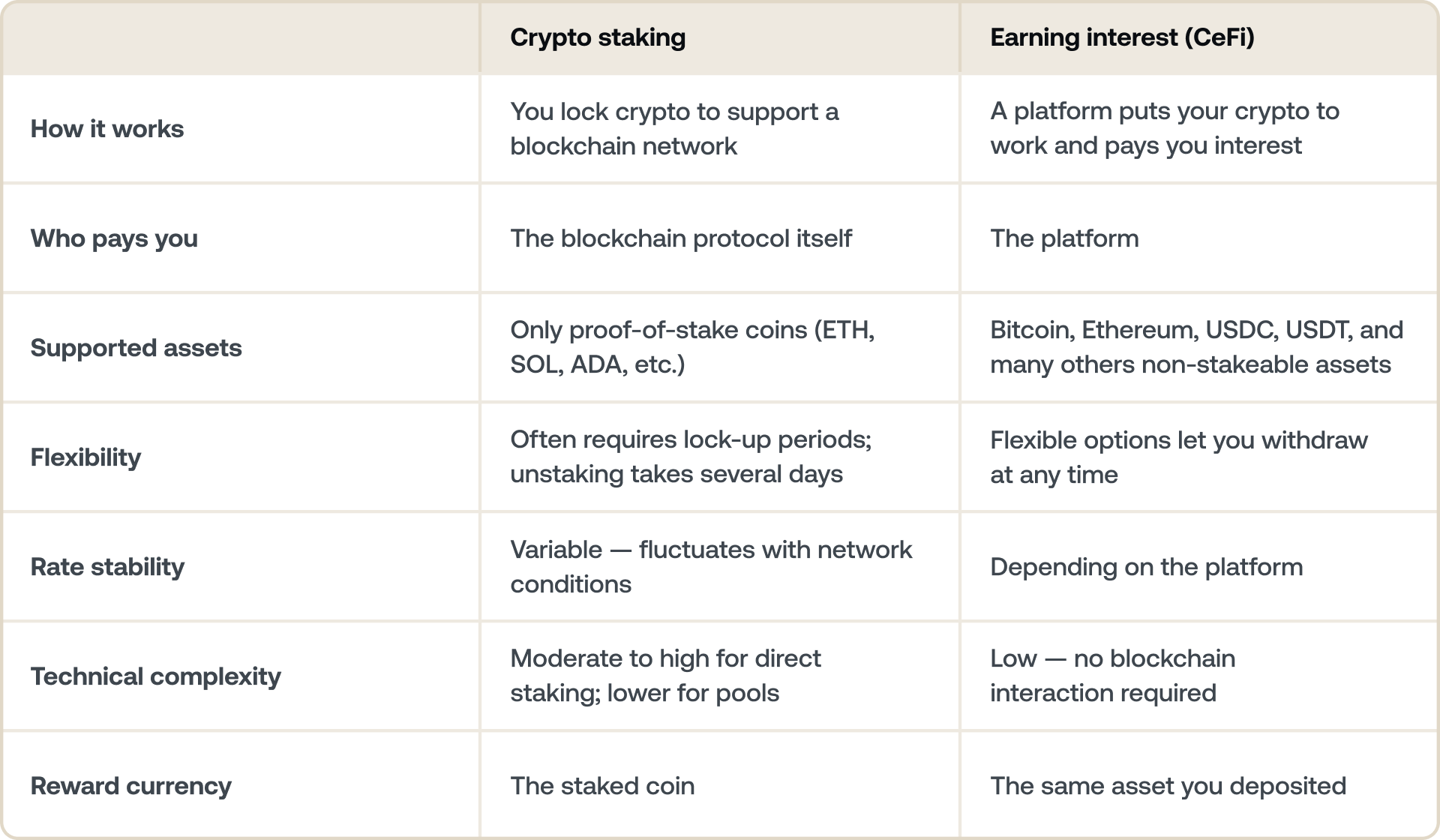
Neither method is universally higher. The proper one is determined by which belongings you maintain, how a lot entry you wish to your funds, and your urge for food for the particular dangers every carries.
When staking tends to make sense: You maintain proof-of-stake cash like ETH or SOL for the long run, you are snug with lock-up durations, and also you need publicity to the community's yield mechanism straight.
When incomes curiosity tends to make sense: You wish to earn on belongings like Bitcoin or stablecoins that may't be staked, you worth flexibility, otherwise you desire a less complicated setup with out managing validator publicity or sensible contract threat.
Many holders do each — staking a portion of their ETH or SOL, and incomes curiosity on stablecoins or Bitcoin individually. If you wish to go deeper on the yield facet, the APR vs. APY explainer is a helpful subsequent learn.
How Nexo's earn merchandise slot in
Nexo's incomes merchandise function on a special mannequin from staking. Fairly than locking crypto right into a validator community, you deposit your belongings with Nexo and earn curiosity, paid day by day, into your account.
Versatile Financial savings — your crypto earns curiosity day by day, and you may withdraw at any time. It really works for over 40 belongings, together with Bitcoin, Ethereum, USDC, USDT, and others that can not be staked in any respect.
Mounted-term Financial savings — you lock your belongings for a set interval in alternate for the next price. It fits holders with a longer-term outlook who need stronger returns. See Fixed-term Savings at a locked-in rate.
Each are simple to arrange. There is no validator to run, no sensible contract to work together with, and no ready interval to unstake.
For present charges throughout belongings, discover Nexo's Savings products.
The underside line
Staking and incomes curiosity each let your crypto work whilst you maintain it — however they function on completely completely different mechanics, carry completely different dangers, and swimsuit completely different belongings. Staking is native to proof-of-stake blockchains and pays protocol-level rewards; incomes curiosity by way of a platform like Nexo applies to a broader vary of belongings with extra predictable phrases and no validator complexity.
Neither method is correct for everybody. The most effective place to begin is knowing each clearly — which is precisely what this information got down to do.
Steadily requested questions
1. What's crypto staking?
Staking is the method of locking up cryptocurrency to assist validate transactions on a proof-of-stake blockchain. In return, stakers obtain rewards — usually paid in the identical coin they staked. It is one of many two principal methods to earn on crypto you already maintain.
2. How does staking crypto work?
You commit a certain quantity of a suitable cryptocurrency (like ETH, SOL, or ADA) to a blockchain community. This alerts that you've a monetary stake within the community behaving appropriately. Validators who run the technical course of obtain rewards; in pooled and liquid staking, these rewards are shared with members such as you.
3. What's the distinction between staking and incomes curiosity on crypto?
Staking ties your crypto to a blockchain community and pays you protocol-level rewards. Incomes curiosity means depositing your crypto with a platform that places it to work and pays you a return. Staking solely works with proof-of-stake cash; incomes curiosity can apply to Bitcoin, stablecoins, and plenty of different belongings that can not be staked.
4. Is staking crypto price it?
It is determined by what you maintain, how lengthy you propose to carry it, and whether or not you are snug with lock-up durations and variable reward charges. For long-term holders of ETH or SOL, staking is usually a significant approach to earn. For individuals who maintain Bitcoin or stablecoins, or who need flexibility, incomes curiosity is usually the extra sensible possibility.
5. What does slashing imply in staking?
Slashing is when a validator loses a portion of their staked crypto as a penalty for behaving incorrectly — both by way of malicious motion or technical failure. In pooled or liquid staking, members share publicity to this threat even when they did not trigger it.
6. Are you able to stake Bitcoin?
No. Bitcoin makes use of proof of labor, not proof of stake. There isn't a native staking mechanism for BTC. To earn on Bitcoin, the obtainable choices are by way of lending platforms or financial savings merchandise that settle for BTC deposits — equivalent to Nexo's Versatile or Mounted-term Financial savings.
7. Are staking rewards taxable?
In most jurisdictions, sure. Staking rewards are usually handled as taxable earnings on the time they're obtained, not when they're bought. The foundations differ considerably by nation, so consulting a certified tax adviser is really useful earlier than staking important quantities.
These supplies are accessible globally, and the supply of this info doesn't represent entry to the companies described, which companies might not be obtainable in sure jurisdictions. These supplies are for common info functions solely and never meant as monetary, authorized, tax, or funding recommendation, provide, solicitation, suggestion, or endorsement to make use of any of the Nexo Companies and will not be customized, or in any manner tailor-made to mirror specific funding aims, monetary scenario or wants. Digital belongings are topic to a excessive diploma of threat, together with however not restricted to unstable market value dynamics, regulatory adjustments, and technological developments. The previous efficiency of digital belongings shouldn't be a dependable indicator of future outcomes. Digital belongings will not be cash or authorized tender, will not be backed by the federal government or by a central financial institution, and most don't have any underlying belongings, income stream, or different supply of worth. Impartial judgment primarily based on private circumstances must be exercised, and session with a certified skilled is really useful earlier than making any determination.