Cryptocurrency Prices by Coinlib
Layer 1 vs Layer 2 Crypto: What is the Distinction?

When you've spent any time in crypto, you've got seen the phrases Layer 1 and Layer 2 — typically shortened to L1 and L2. They arrive up in conversations about gasoline charges, Ethereum, Bitcoin, and why some transactions are quick and low-cost whereas others really feel sluggish and costly.
They don't seem to be as sophisticated as they sound. This is what they really imply, why the excellence issues, and the way the 2 layers work collectively.
Fast reply
Layer 1 is the bottom blockchain — the principle community that information and secures all transactions (e.g., Ethereum, Bitcoin).
Layer 2 is a separate community constructed on high of Layer 1. It processes transactions sooner and at decrease value, then settles the ultimate outcomes again on Layer 1.
Consider Layer 1 because the freeway infrastructure, and Layer 2 because the categorical lanes constructed on high to cut back congestion.
What's Layer 1?
Layer 1 is the bottom blockchain — the underlying community that validates transactions, maintains the ledger, and enforces the foundations. If you ship Bitcoin or work together with an Ethereum sensible contract instantly, you are utilizing Layer 1.
Properly-known Layer 1 blockchains embrace:
Ethereum — the inspiration for many DeFi apps, NFTs, and sensible contracts
Bitcoin — the unique blockchain, primarily used as a retailer of worth and cost community
Solana and Avalanche — various L1s constructed to be sooner out of the field
Layer 1 blockchains are self-securing. Their validator networks (miners or stakers, relying on the consensus mechanism) affirm each transaction and make the community proof against tampering.
The trade-off: as a result of each node should course of each transaction to keep up that safety, L1 networks have restricted throughput. Ethereum handles roughly 15 transactions per second. Bitcoin handles round seven. When demand is excessive, charges spike and affirmation instances decelerate.
What's Layer 2?
Layer 2 is a separate community constructed on high of a Layer 1 blockchain. Its job is to course of transactions off the principle chain — sooner and cheaper — then periodically report the outcomes again to Layer 1 for remaining settlement.
The important thing level: Layer 2 would not substitute Layer 1. It makes use of L1 as its safety basis. The bottom chain remains to be the final word supply of reality.
Standard Layer 2 networks on Ethereum embrace Arbitrum, Optimism, Base (constructed by Coinbase), zkSync, and Linea (constructed by Consensys). On Bitcoin, the Lightning Community performs an analogous position for quick, low-cost funds.
How does Layer 2 work?
The commonest Layer 2 method as we speak is rollups. The identify explains the mechanic: transactions are “rolled up” into batches off-chain, and solely the compressed abstract is posted to Ethereum.
As an alternative of paying for every transaction individually on the principle chain, you share the price of one batch with a whole lot or 1000's of different customers. That is how L2 charges can drop to some cents even when Ethereum mainnet charges are a number of {dollars}.
There are two important forms of rollups:
Optimistic rollups
Transactions are assumed to be legitimate by default. Anybody can problem a suspicious transaction throughout a dispute window. If no problem is raised, the batch is accepted. This method is easier to construct and is utilized by Arbitrum, Optimism, and Base.
Zero-knowledge rollups (ZK-rollups)
Each batch comes with a cryptographic proof — a mathematical assure that the transactions are legitimate — verified on Ethereum earlier than the batch is accepted. ZK-rollups like zkSync and Linea supply sooner finality and stronger ensures, although they're extra advanced to construct.
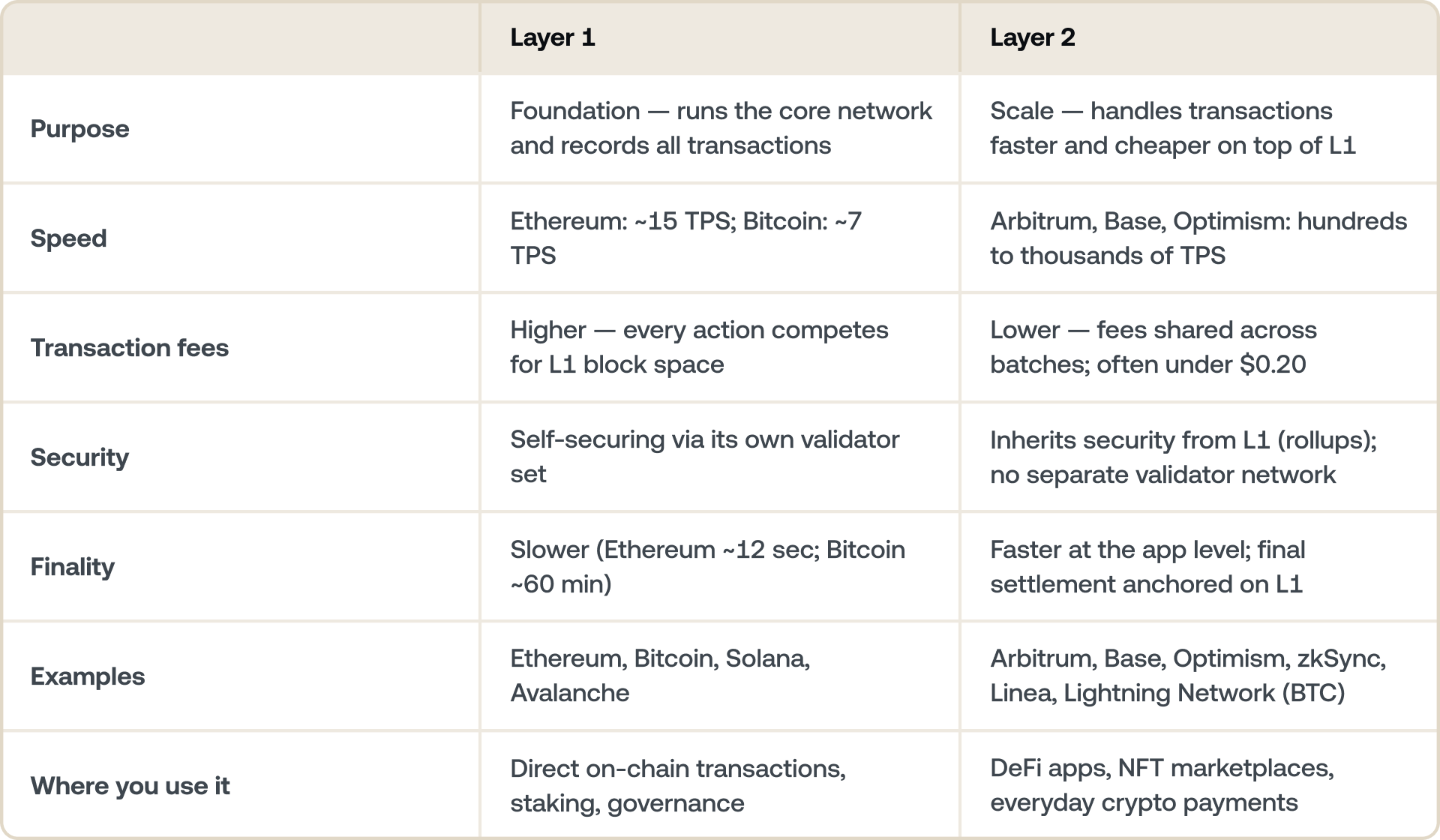
Layer 1 vs layer 2: facet by facet
Why does this distinction matter for you?
In apply, the Layer 1 vs Layer 2 distinction impacts three stuff you encounter instantly:
Transaction charges
Ethereum mainnet charges can vary from a number of {dollars} to tens of {dollars} when the community is busy. The identical transaction on Arbitrum or Base sometimes prices nicely beneath $0.20. When you're utilizing DeFi, buying and selling, or sending crypto usually, that distinction compounds shortly.
Pace
Layer 2 networks affirm transactions in seconds on the app stage. Finality — the purpose at which a transaction is everlasting — is anchored again on Ethereum, however you will not discover the delay in on a regular basis use.
The place your belongings truly are
If you transfer belongings to a Layer 2 community, they are not on the Ethereum mainnet anymore. They're on a separate chain that finally settles again to Ethereum. Most wallets and apps make this seamless, nevertheless it's price understanding in the event you're ever troubleshooting a transaction or selecting the place to carry belongings.
Nexo supports 100+ digital assets — together with main L1S like Bitcoin, Ethereum, and Solana, in addition to fashionable L2-native tokens. Whether or not you need to earn in your holdings, borrow towards them, or commerce throughout belongings, the whole lot is on the market in a single place.
Just a few issues price realizing
Layer 2 is an actual enchancment, nevertheless it introduces some nuances:
Transferring belongings between L1 and L2 makes use of a bridge — a wise contract that locks belongings on one facet and releases them on the opposite. Bridges have been the goal of a few of the largest hacks in crypto. At all times use well-established bridges and be cautious with newer ones.
On optimistic rollups, withdrawing belongings again to the Ethereum mainnet entails a problem window — sometimes round seven days. ZK-rollups and centralized bridges will be sooner, however they carry totally different trade-offs.
With dozens of L2S now reside, liquidity and apps are unfold throughout chains. Not each app or asset is on the market on each community.
Layer 2 expertise has improved quickly, however most networks are nonetheless youthful than the Ethereum mainnet. Ethereum's personal documentation notes that no L2 is as battle-tested as L1 but.
The underside line
Layer 1 and Layer 2 aren't competing concepts — they're designed to work collectively. Layer 1 offers the safety and finality that make the entire system reliable. Layer 2 makes it quick and inexpensive sufficient for on a regular basis use. Understanding each provides you a clearer map of how the crypto ecosystem is definitely constructed, and helps you make higher choices about the place to carry, transfer, and use your belongings.
Continuously requested questions
1. What's Layer 1 in crypto?
Layer 1 is the bottom blockchain community — the principle chain that information and secures all transactions. Ethereum and Bitcoin are probably the most well-known examples. Each transaction that occurs on a Layer 2 finally settles again on a Layer 1.
2. What's Layer 2 in crypto?
Layer 2 is a community constructed on high of a Layer 1 blockchain. It processes transactions off the principle chain to cut back charges and enhance velocity, then posts the outcomes again to Layer 1 for settlement. Examples embrace Arbitrum, Base, Optimism, and zkSync on Ethereum, and the Lightning Community on Bitcoin.
3. Why do Layer 2 charges value much less?
Layer 2 networks batch a whole lot of transactions collectively and submit them to Ethereum as a single entry. The L1 price is break up throughout everybody within the batch, so every consumer pays a fraction of what they'd pay for a direct mainnet transaction.
4. Is Layer 2 as safe as Layer 1?
Rollup-based Layer 2 networks inherit their safety from Ethereum — the underlying knowledge and remaining settlement reside on the principle chain. Nevertheless, most L2s are newer and have much less battle-tested infrastructure than Ethereum mainnet itself. It is price doing your individual analysis earlier than utilizing any L2 for big transactions.
5. What's the distinction between an optimistic rollup and a ZK-rollup?
Optimistic rollups assume transactions are legitimate and permit a problem interval for disputes. ZK-rollups generate a cryptographic proof for each batch, verified on Ethereum earlier than acceptance. Optimistic rollups are easier and extensively adopted; ZK-rollups supply sooner finality and stronger mathematical ensures.
6. Is Linea a Layer 2?
Sure. Linea is a ZK-rollup constructed by Consensys — the workforce behind MetaMask and the Infura developer platform. It runs on high of Ethereum, providing decrease charges and sooner transactions whereas inheriting Ethereum's safety.
7. Do I would like to make use of Layer 2?
Not essentially. When you maintain belongings long-term with out frequent transactions, you might by no means have to work together with a Layer 2 instantly. However in the event you use DeFi apps, commerce typically, or need to scale back charges, Layer 2 networks supply a meaningfully higher expertise than transacting instantly on the Ethereum mainnet.
These supplies are accessible globally, and the provision of this info doesn't represent entry to the providers described, which providers is probably not obtainable in sure jurisdictions. These supplies are for basic info functions solely and never supposed as monetary, authorized, tax or funding recommendation, supply, solicitation, advice, or endorsement to make use of any of the Nexo Providers and aren't customized, or in any manner tailor-made to mirror explicit funding targets, monetary scenario or wants. Digital belongings are topic to a excessive diploma of threat, together with however not restricted to risky market worth dynamics, regulatory modifications, and technological developments. The previous efficiency of digital belongings isn't a dependable indicator of future outcomes. Digital belongings aren't cash or authorized tender, aren't backed by the federal government or by a central financial institution, and most do not need any underlying belongings, income stream, or one other supply of worth. Impartial judgment based mostly on private circumstances needs to be exercised, and session with a certified skilled is beneficial earlier than making any resolution.