Cryptocurrency Prices by Coinlib
Sui Or Ethereum? How The Two Chains Differ On Finality, Charges And Design – EGamers.io – P2E NFT Video games Portal

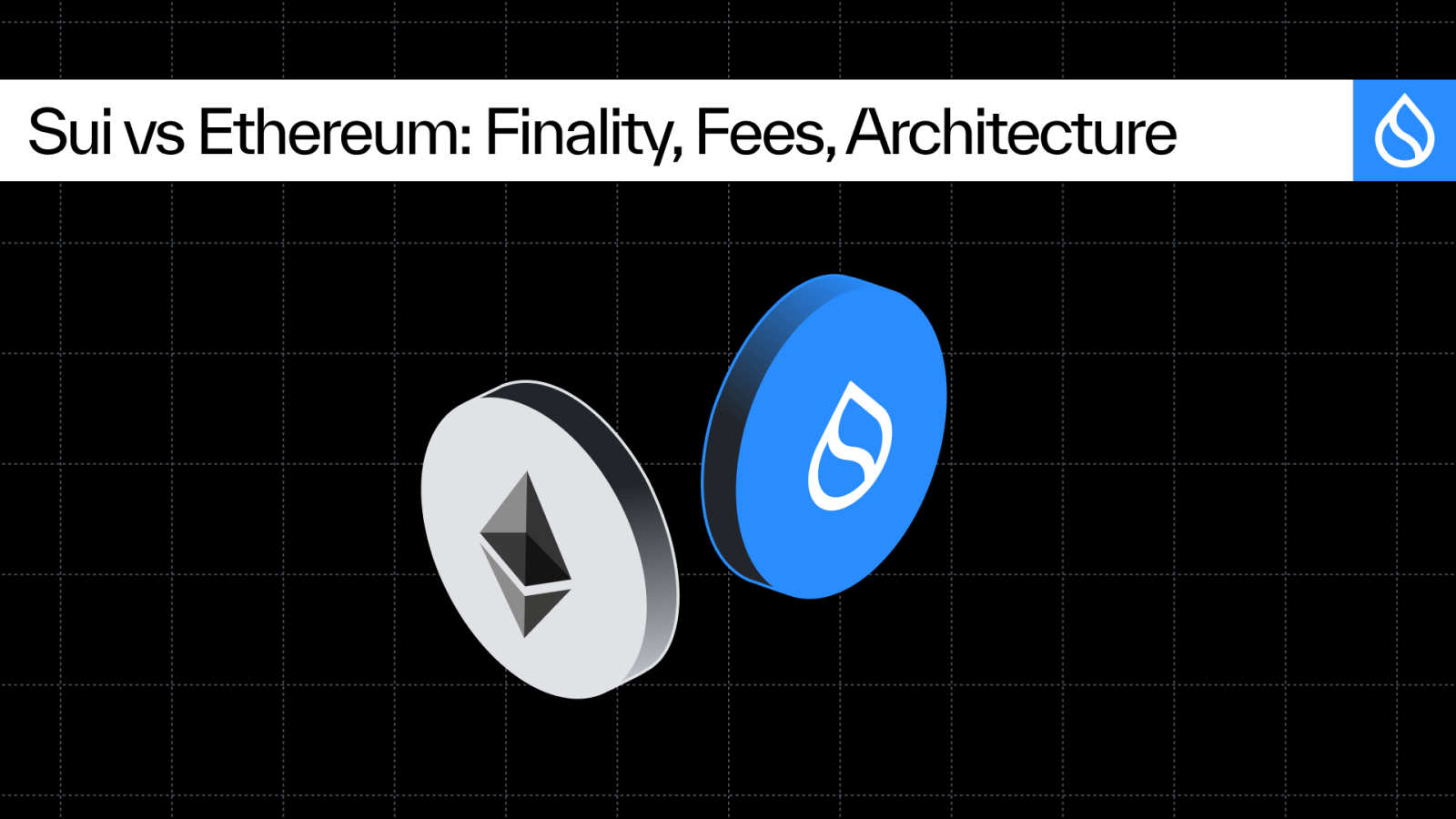
Get our tales first on GoogleAdd egamers.io as a most well-liked supply and our reporting reveals up greater in your Prime Tales.Each Sui and Ethereum execute sensible contracts, but they scale in reverse methods. Ethereum retains its base layer conservative and strikes most exercise to Layer 2 rollups. Sui launched in 2023 and scales on the bottom layer itself. It settles transactions in about 390 milliseconds, and its contracts are written in Transfer, a language designed in order that widespread asset bugs fail to compile. If you happen to play or commerce on both chain, three questions matter most: how briskly a transaction settles, how a lot it prices and what number of layers stand between you and the app.Ethereum is the established participant. September 2026 figures put roughly $49 billion in Ethereum DeFi, in contrast with $5.9 billion on Solana and $473 million on Sui. Ethereum additionally leads on developer rely, variety of audited contracts and size of monitor document. Sui started with a contemporary design and will research the place first-generation chains bumped into their limits.One layer or many rollupsRollups sit on the heart of Ethereum’s roadmap. They now deal with about 95 % of Ethereum’s transactions, and the principle chain often runs nicely below its block goal. Rollups are available in two primary sorts. Optimistic rollups deal with transactions as legitimate by default and rely upon a problem window, usually seven days, earlier than withdrawals to mainnet are remaining. Zero-knowledge rollups submit validity proofs, so withdrawals finalize sooner.The financial savings come from operating transactions off the principle chain and sending outcomes again in compressed batches, which suggests a single posting price pays for your entire batch. EIP-4844 created a separate lane for that batch information, often known as blobs, with pricing aside from execution gasoline and deletion after a brief interval. In Might 2025, Pectra doubled blob capability. Fusaka’s PeerDAS went reside in December 2025 and raised capability once more by letting validators pattern blob information with out downloading the complete set.The trade-off is complexity. Builders should select a rollup, determine how liquidity is split between rollups and handle the motion of worth and messages throughout layers. On mainnet, composability (any contract with the ability to name another) was one in every of Ethereum’s strengths. That weakens when apps reside on completely different rollups with out direct shared state.Sui runs all the things on a single layer. Due to its object mannequin, the chain is aware of precisely which objects every transaction touches, so transactions with out overlap execute in parallel. Including {hardware} raises throughput with no congestion pricing, and builders by no means have to choose a rollup or work with cross-layer bridges.Finality: 390 milliseconds versus 15 minutesEthereum creates a block about each 12 seconds, and a transaction included in a block is mostly thought of confirmed inside that point. Reaching full finality takes about quarter-hour, because it covers two consensus epochs. Single-slot finality would reduce that down, nevertheless it stays in analysis and is predicted solely after large upgrades like Verkle bushes and Danksharding. For many every day use, the block time is the true wait. For top-value settlement, the 15-minute determine is what issues.Sui reaches deterministic finality in about 390 milliseconds. After a transaction settles, no probabilistic ready interval follows. This counts for funds, buying and selling and any app the place customers would discover a lag.Charges are actually closeEthereum has grow to be cheaper. In Might 2026, commonplace gasoline sat at round 0.15 gwei, placing a primary ETH switch under $0.03, an ERC-20 switch at about $0.08 and a token swap at about $0.21. On Layer 2, charges are a fraction of a cent.A median Sui transaction prices lower than $0.02. On the protocol stage, stablecoin transfers on Sui are gasless, so sending them is free no matter quantity. For bizarre transactions, the distinction has largely disappeared. What Sui nonetheless has over Ethereum is free stablecoin transfers and no congestion pricing throughout demand spikes.Safety: historical past or language designEthereum’s argument rests on its previous. The EVM has been operating since 2015, billions of {dollars} have examined it below stress, and it has the largest assortment of audited libraries and hardened patterns in crypto.Sui’s argument begins with the language. Most giant sensible contract exploits occurred as a result of Solidity allowed harmful patterns to compile, together with the reentrancy bugs and accounting errors which have drained billions. Sam Blackshear, Transfer’s creator and a co-founder of Mysten Labs, constructed the language so these patterns can't be written within the first place. In Transfer, belongings are assets, and the kind system prevents them from being copied or destroyed. Sui’s object mannequin additionally assigns each asset express on-chain possession.Sui tasks nonetheless want audits. Along with HackenProof, the Sui Basis operates the Sui Safety Enlargement Program, which presents ecosystem tasks bug bounties, crowdsourced audits and pre-launch assessment by Transfer and Rust researchers. Six companies audit Sui tasks: Asymptotic, which created the Sui Prover for formal verification of Transfer contracts; Certora; MoveBit; OtterSec; Zellic; and Blaize.Safety. Transfer Registry posts bundle supply, documentation and audit stories on-chain alongside the deployed contract, so anybody can verify what was audited in opposition to what is definitely operating.What Sui builds inSui comes with a number of parts of its personal:Walrus for decentralized storageSeal, which encrypts information and controls who is ready to decrypt itNautilus for trusted off-chain computationDeepBook for on-chain liquidityzkLogin for one-step sign-in utilizing an present Google or Apple accountConfidential transfers, in public beta on devnet, which hold transaction quantities out of public view whereas letting particular events see them when requiredThe items gamers will discover day after day are zkLogin and gasless stablecoins: logging in with an account they already personal and sending stablecoins with no charges. Ethereum has equivalents, however they arrive from separate third-party tasks, a lot of them good, which builders assemble and should belief one after the other. Ethereum’s open ecosystem provides extra choices and extra mature parts. Sui’s method means fewer selections to make and elements constructed to suit collectively.Matching tasks to chainsEthereum and its rollups make sense for tasks that depend on present Ethereum DeFi liquidity, want the largest pool of Solidity builders or achieve from EVM community results. Sui targets tasks that want excessive base-layer throughput, sub-second deterministic finality, language-enforced asset security and gasless stablecoin transfers. That features funds, client apps at scale and gaming marketplaces like OVERTAKE, which gives on-chain escrow and creator storefronts for avid gamers who commerce, pay and promote on-line.Sui has no Layer 2s. Parallel execution lets it scale on the bottom layer, so apps stay on a single layer and might name each other instantly.
Source link