Cryptocurrency Prices by Coinlib
Carnegie Mellon's OATs Give Family Objects Tamagotchi-style AI Faces That Sulk When Ignored – EGamers.io – P2E NFT Video games Portal

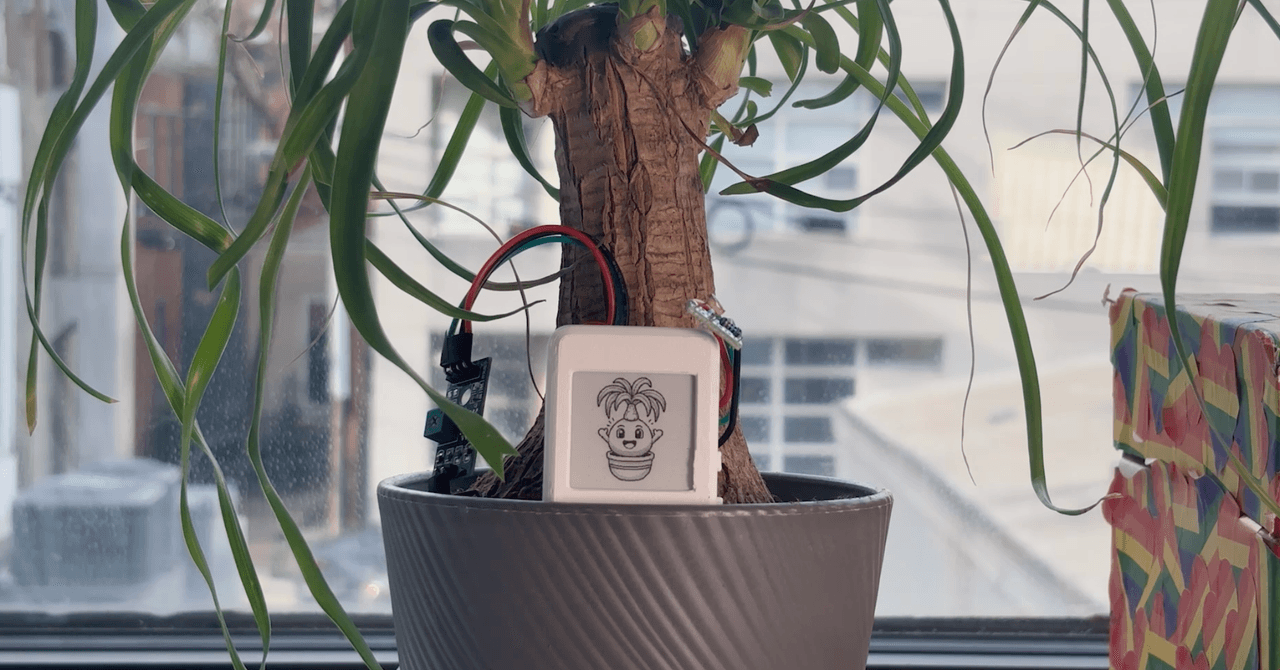
Get our tales first on GoogleAdd egamers.io as a most popular supply and our reporting reveals up increased in your High Tales.A houseplant has no method to say it wants water. A $20 module connected to its pot does: it reveals a small unhappy face on an E Ink display till somebody fetches the watering can, and the face brightens as soon as the soil will get moist.The modules are referred to as OATs, which stands for Object Agent Twins. Every one is a micro-agent AI avatar on a tiny E Ink show, designed to be paired with an on a regular basis family object. They have been created by Daehwa Kim, a fifth-year PhD scholar in Carnegie Mellon’s Future Interfaces Group.In early November, Kim confirmed the venture on the ACM Symposium on Person Interface Software program and Know-how in Detroit, the place lecturers and trade consultants collect to discover human-computer interfaces. She got here away with two Honorable Point out awards.A Tamagotchi for the espresso machineAnyone who grew up within the ’90s will spot the inspiration. Tamagotchi have been egg-shaped toys containing digital pets that demanded real-time care and a focus. Kim wished to convey that feeling to bodily issues individuals have already got at residence.“We convey this pleasure of caring from digital to bodily objects,” Kim mentioned.Her argument begins with screens. In accordance with Kim, individuals take a look at cellular gadgets all day, and AI brokers, together with these constructed to finish duties for you, preserve dragging consideration again to the smartphone. OATs put these interactions out within the room as a substitute.The use instances are easy. Connect one to a skateboard you by no means get round to driving, and after a number of days with out detected movement, the avatar turns unhappy and lonely. Hop on the board and it flips to completely satisfied, goofy expressions. “These sorts of inanimate objects will be extra expressive,” Kim mentioned.Three patterns from testersKim mentioned she handed OATs to many individuals and seen three sorts of use.The primary responds to the query “Am I getting used?” A espresso machine is one instance: its avatar will get excited when the grinder begins on the beans. The second is alerting people who find themselves close to an object. As a result of 3D printers give off poisonous fumes whereas operating, an OAT on a printer can let individuals understand it’s in use. The third is behavior monitoring. One tester put an OAT on a dumbbell to log how typically they lifted, and stored exercising usually so the AI pet wouldn’t be let down.The demo on the symposium attracted a crowd, and Kim made it right into a contest for essentially the most fascinating object pairings. Her web site hosts a gallery of sprites individuals created, together with an animated convention badge and a panda avatar for an Owala water bottle.Low value, quick battery lifeEach OAT incorporates an E Ink show linked to inside and exterior sensors that may measure moisture, temperature, humidity, gentle, occupancy and movement. The primary module is priced at round $20.Customers set it up by way of an internet portal, giving the OAT a reputation and selecting the sensors that swimsuit the article it should sit on. The sprites are generated by Google Gemini’s Nano Banana image-generation service, which creates a spread of feelings for various states relying on the sensor knowledge.The online app additionally drafts “Optimistic” and “Destructive” behaviors primarily based on the article’s title and outline. For a plant that prefers dry circumstances, constructive triggers might embrace “constant air temperature readings” and “low humidity ranges.” House owners can change these to suit their specific plant.Energy is the principle downside. On its lithium-ion polymer battery, an OAT runs for about three to 4 days, dropping to a single day when used with the sound stage sensor. Charging is through USB-C. That limitation is a big motive the venture stays a proof of idea and isn’t a product.Kim has been urged to promote OATs kits on-line, however she hasn’t determined whether or not to construct a enterprise round it.The difficulty with cute AIGiving AI a bodily kind has been tried earlier than. Corporations preserve looking for “the following smartphone,” from the failed Humane Ai Pin to OpenAI’s upcoming {hardware} developed with former Apple designer Jony Ive to Meta’s Muse Appeal, a pocket-sized system operating Meta’s Muse AI agent that's anticipated to launch in December. More and more, these firms are counting on cuteness to win individuals over.The demo additionally prompted a prolonged debate about anthropomorphizing AI, and whether or not it’s acceptable to present these sprites human-like traits and feelings so individuals really feel connected to them.The AI trade does this on a regular basis. Chatbots “hallucinate.” This summer time, Anthropic introduced a “dreaming” function during which its AI agent tidied its native reminiscence as a background course of. Human language like this could skew ethical judgments about AI and push individuals to belief the instruments greater than they need to.Kim mentioned that is the explanation OATs are restricted to expressive feelings on an E Ink show and supply no different interactions.“Anthropomorphism will be very helpful in sure methods, like serving to individuals to vary their behaviors,” Kim mentioned. “Folks title their automotive, and so they title their bike. I hardly ever see individuals who title their iPhone. I really feel like in the way forward for computing, we may have extra of a relationship with AI, however we should always undoubtedly watch out to not abuse this.”
Source link