
Cryptocurrency Prices by Coinlib
Crypto vs. Shares: Methods to Assume About Each

Ask most traders whether or not they want crypto or shares, and you will get a robust opinion. What you will not get, more often than not, is a helpful framework.
The crypto vs. shares debate will get framed as a contest — as if selecting one means abandoning the opposite. However the extra helpful query is what function every performs in a portfolio, and what you really need to grasp about every earlier than placing cash in.
This information covers the true variations between the 2, how the danger and return profiles evaluate, and the way to consider holding each.
They're various kinds of belongings
An important factor to grasp about crypto and shares is that they signify essentially various things.
Shares are fractional possession of an organization. Whenever you purchase a share of Apple or a fund that tracks the S&P 500, you personal a small piece of a enterprise with revenues, income, workers, and belongings. The worth of a inventory is in the end tied to the underlying firm's efficiency — present earnings, future development expectations, and the broader financial system.
Cryptocurrencies are digital belongings. Bitcoin is not a share of an organization — it is a decentralized retailer of worth with a set provide cap of 21 million cash. Ethereum is a programmable blockchain whose token worth is tied to demand for the community. Totally different cryptocurrencies have totally completely different worth drivers: community adoption, tokenomics, utility, and market sentiment all play a job that has no direct analog in fairness markets.
This issues as a result of the issues that transfer inventory costs and the issues that transfer crypto costs are sometimes completely different, which is each a supply of threat and an argument for holding each.
How the danger profiles evaluate
Neither asset class is inherently “secure” or “dangerous” in absolute phrases. However the nature of the danger is completely different.
Volatility. Crypto tends to be extra unstable than most equities. Bitcoin has skilled a number of vital drawdowns since 2011 — and has recovered from every of them. The S&P 500 has traditionally seen smaller peak-to-trough losses, with recoveries that are likely to comply with extra established patterns. Altcoins can even see sharp declines throughout bear markets. In case your time horizon is shorter or you may have a decrease tolerance for drawdowns, that is price factoring into your pondering.
Liquidity and market hours. Crypto markets commerce 24 hours a day, seven days every week, together with holidays. Inventory markets shut. For many long-term traders that is irrelevant, nevertheless it means crypto costs can transfer considerably when you're sleeping — and you'll at all times exit a place immediately.
Regulation. Shares function inside a well-established regulatory framework. Corporations should file audited accounts; brokerages should meet capital necessities; traders have sure authorized protections. Crypto regulation remains to be evolving throughout most jurisdictions, which introduces uncertainty — but in addition creates home windows of alternative as readability improves.
What the returns image really reveals
When you'd invested $1,000 in Bitcoin in January 2015, that funding could be price considerably extra in the present day — typically cited as a 100x+ return over that interval. The identical $1,000 within the S&P 500 could be price roughly $2,500–3,000, together with dividends reinvested.
That comparability is actual — nevertheless it's additionally the best-case framing. Crypto returns are closely depending on once you purchased and once you measure. Traders who purchased on the 2021 peak and offered in 2022 skilled vital losses. Traders who purchased throughout the 2018 or 2022 bear markets and held by way of the restoration did extraordinarily effectively.
The trustworthy image: crypto has traditionally outperformed most main asset lessons over the long term, however with way more volatility and extra extreme drawdown intervals than equities. These returns aren't free — they arrive with the expertise of watching your portfolio drop 60% earlier than recovering.
Previous efficiency just isn't a dependable indicator of future outcomes. All return figures are illustrative and based mostly on historic knowledge.
Inventory returns are extra predictable over very long time horizons. The S&P 500 has returned roughly 10% yearly on common over the previous century, with a restoration from each main crash. The trade-off is decrease upside.
The ten% determine is a long-run historic common for the US market. Particular person years range considerably, and previous index efficiency doesn't assure future returns.
Crypto can do one thing shares usually cannot
One dimension most crypto vs. shares comparisons miss totally: crypto can earn a return when you maintain it, past value appreciation alone.
Some shares pay dividends — a share of firm's income distributed to shareholders. However the majority of crypto, sitting idle in a pockets or on an change, earns nothing by default.
That adjustments once you put it to work. Proof-of-stake cash like ETH will be staked to earn protocol-level rewards.
Past simply holding, some crypto platforms allow you to put belongings like Bitcoin or stablecoins like USDC to work — incomes curiosity in your holdings, typically paid each day.
This implies a crypto allocation can operate extra like a yield-bearing asset than a purely speculative one, relying on the way you handle it. A Bitcoin holder who earns a return on their holdings whereas ready for value appreciation is in a distinct place than one who holds and waits passively.
The case for holding each
Crypto and shares aren't mutually unique. Most traders who maintain crypto deal with it as one allocation inside a broader portfolio — not as a alternative for equities.
Within the early years of crypto, Bitcoin had low correlation to inventory markets and moved largely independently. Extra lately, significantly throughout macro stress occasions, crypto and shares have tended to fall collectively — the correlation elevated as institutional traders started holding each. That stated, the correlation is not constant, and crypto can even rally in periods of fairness stagnation.
A sensible approach to consider it: crypto provides uneven upside and completely different threat drivers to a portfolio that is in any other case pushed by firm earnings and macroeconomic cycles.
Frequent portfolio allocation frameworks amongst retail traders vary from 5% to twenty% in crypto, with the remainder in equities, bonds, and different belongings. The correct quantity relies upon totally in your private state of affairs: your time horizon, your earnings stability, and your potential to take a seat by way of a major drawdown with out making reactive choices.
These are common frameworks for illustrative functions solely and don't represent monetary or funding recommendation. Your acceptable allocation will rely in your particular person circumstances. Seek the advice of a certified monetary adviser earlier than making funding choices.
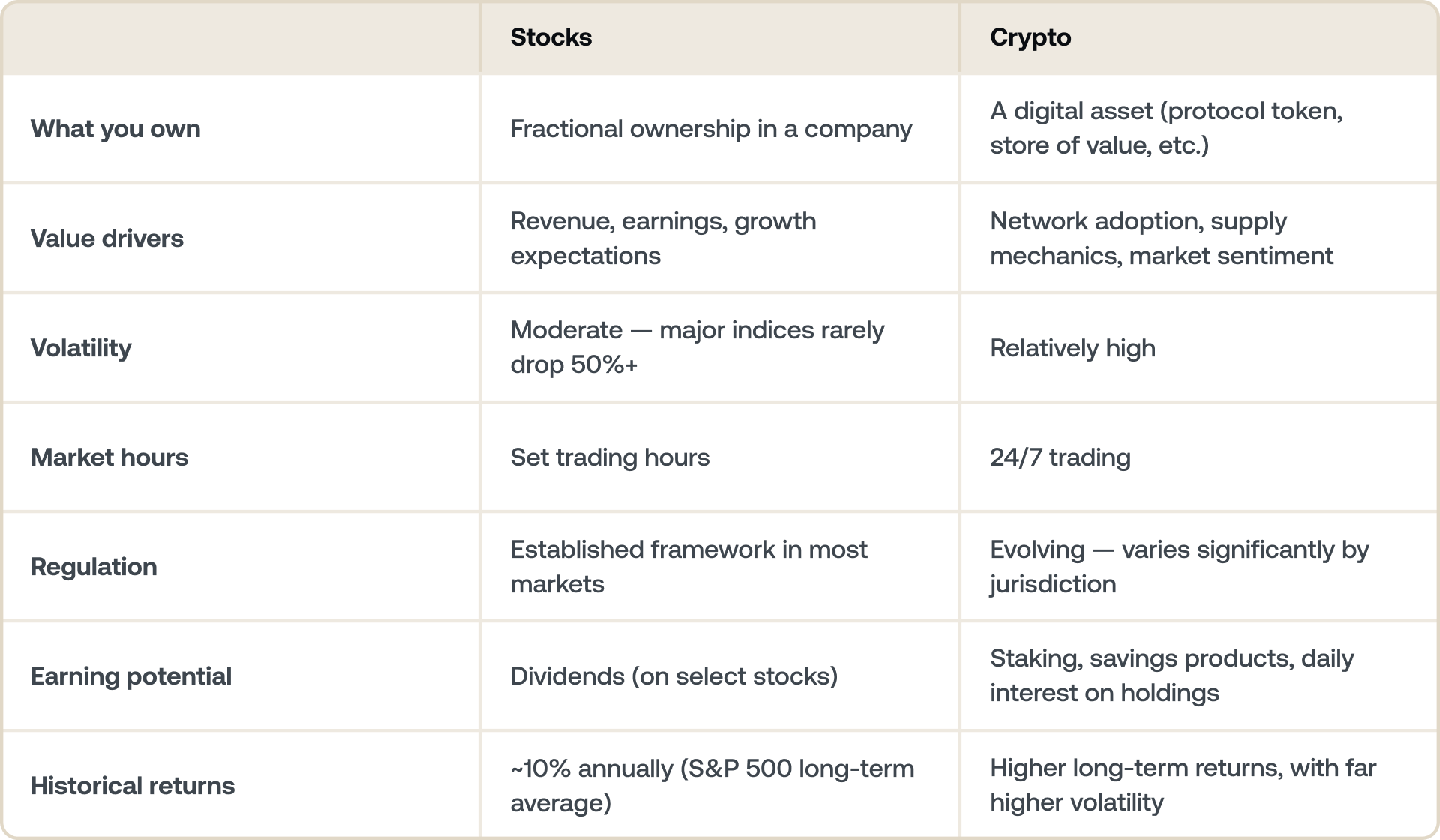
Crypto vs. shares at a look
Making your crypto work more durable
When you already maintain crypto as a part of your portfolio, the following query is how actively you need to handle it.
Nexo's incomes merchandise allow you to put your holdings to work.
Versatile Financial savings pays daily interest on over 40 assets — together with Bitcoin, Ethereum, USDC, and USDT — with no lock-up interval.
For holders who need a stronger price and are comfy committing for a set interval, Fixed-term Savings at a locked-in rate offer you increased returns in change for an outlined time period.
Notice: Rates of interest are variable, topic to alter, and should differ based mostly in your location, Loyalty Tier, and asset held
The underside line
Crypto and shares are completely different devices with completely different threat profiles, completely different return histories, and completely different roles in a portfolio. The query is not which one wins — it is how every matches your targets, your time horizon, and your capability to handle threat.
The traders who are likely to do greatest with crypto are those that deal with it as a deliberate allocation reasonably than a guess: sized appropriately, understood clearly, and ideally incomes one thing whereas they wait.
Ceaselessly requested questions
1. Is crypto higher than shares?
Neither is objectively higher — they serve completely different features in a portfolio. Crypto has delivered increased long-term returns than most fairness indices however with considerably extra volatility and deeper drawdowns. Shares supply extra predictable returns over lengthy horizons. Most traders who maintain crypto deal with it as one allocation inside a broader portfolio, not as a alternative for equities.
2. What are the principle variations between crypto and shares?
Shares signify fractional possession in an organization; crypto is a digital asset with its personal worth drivers. Key variations embody: shares have established regulatory frameworks whereas crypto regulation remains to be evolving; inventory markets have set buying and selling hours whereas crypto trades 24/7; crypto is extra unstable; and crypto holdings can earn yield by way of staking or financial savings merchandise, whereas solely choose shares pay dividends.
3. Can crypto and shares be held collectively?
Sure, and lots of traders do. The correlation between crypto and conventional markets has elevated in recent times, however they nonetheless transfer in a different way sufficient to supply some diversification profit. Combining them additionally offers publicity to completely different return drivers — firm earnings on the fairness aspect, and community adoption and provide dynamics on the crypto aspect.
4. Does crypto pay dividends like shares?
Not within the conventional sense. However crypto holdings can generate yield by way of staking (on proof-of-stake networks like Ethereum) or by way of financial savings merchandise that pay each day curiosity on deposited belongings.
These supplies are accessible globally, and the supply of this data doesn't represent entry to the companies described, which companies might not be accessible in sure jurisdictions. These supplies are for common data functions solely and never supposed as monetary, authorized, tax, or funding recommendation, supply, solicitation, advice, or endorsement to make use of any of the Nexo Companies and will not be customized, or in any approach tailor-made to replicate explicit funding aims, monetary state of affairs or wants. Digital belongings are topic to a excessive diploma of threat, together with however not restricted to unstable market value dynamics, regulatory adjustments, and technological developments. The previous efficiency of digital belongings just isn't a dependable indicator of future outcomes. Digital belongings will not be cash or authorized tender, will not be backed by the federal government or by a central financial institution, and most shouldn't have any underlying belongings, income stream, or different supply of worth. Unbiased judgment based mostly on private circumstances must be exercised, and session with a certified skilled is advisable earlier than making any resolution.