
Cryptocurrency Prices by Coinlib
Crypto Banking Defined: Banks vs. Platforms

The brief model
Crypto banking is the final time period for holding, transferring, or rising digital property by a monetary supplier — whether or not that is a financial institution, a fintech app, or a devoted platform.
A crypto-friendly financial institution is a licensed, deposit-insured financial institution. It merely does not block transfers to crypto exchanges.
A crypto financial institution is a licensed banking establishment. It’s uncommon, and often chartered exterior the U.S. and holds crypto as a core a part of its steadiness sheet.
A neobank with crypto options is an app-based checking account constructed on a associate financial institution's constitution. It bolts on restricted shopping for and promoting of crypto.
A non-bank crypto platform holds no banking license in any respect. It is constructed particularly to allow you to maintain, earn on, and borrow in opposition to crypto. Custody and compliance requirements are designed for digital property, not tailored from conventional banking.
What's crypto banking?
Crypto banking is not a single regulated class — it is a catch-all for anyplace you'll be able to maintain or handle digital property alongside (or as a substitute of) conventional cash.
That is why the time period will get utilized loosely to 4 genuinely completely different setups: an atypical financial institution that simply does not block crypto transfers, a licensed establishment constructed round crypto from the bottom up, a digital checking account with a crypto function bolted on, and a devoted platform with no banking license in any respect.
The sections beneath break down what each is, because the variations decide what occurs to your cash.
What's a crypto-friendly financial institution?
A crypto-friendly financial institution is an atypical, totally licensed retail or enterprise financial institution. It has a banking constitution, deposit insurance coverage (FDIC within the US, comparable schemes elsewhere), and a regulator that examines its books. What units it aside is easy: it does not prohibit clients from transferring cash to and from crypto exchanges. Some banks nonetheless flag, delay, or outright block card funds and wire transfers to crypto platforms as a fraud-prevention measure. A crypto-friendly financial institution does not do this.
Past not blocking transfers, crypto-friendly banks typically do not supply any crypto-specific merchandise themselves. Your checking account, financial savings account, and debit card work precisely as they'd at every other financial institution.
The “crypto-friendly” label simply means the financial institution stays out of your approach if you need to fund a crypto buy or money out to fiat. That is the class most individuals are literally attempting to find once they search “which financial institution helps crypto.” It is value figuring out earlier than you get a declined transaction on the worst doable second.
What's a crypto financial institution?
A crypto financial institution is a licensed banking establishment constructed particularly round digital property. It holds an precise banking constitution, not only a partnership with one, and crypto sits on the middle of its enterprise quite than as an add-on.
A small variety of these exist globally, principally beneath specialised frameworks like Switzerland's banking license for digital-asset companies. As a result of they're licensed, they will supply issues an unlicensed platform legally can't: regulated custody paired with conventional deposit-taking, or crypto-collateralized accounts that sit contained in the banking system itself.
Real crypto banks are nonetheless unusual. The time period will get misapplied consistently to corporations that are not banks in any respect. If a platform does not disclose an precise banking license from a named regulator, it is not a crypto financial institution within the strict sense.
What's a neobank with crypto options?
A neobank is a digital-only checking account, often mobile-first. It does not maintain its personal banking constitution — it points accounts by a licensed associate financial institution behind the scenes. Your deposits are usually nonetheless coated by that associate financial institution's deposit insurance coverage. Some neobanks have added crypto options on high of this banking infrastructure: shopping for a small number of cash, rounding up spare turn into Bitcoin, or viewing a crypto steadiness alongside your checking account.
The crypto layer on a neobank is often skinny by design. You are typically restricted to a handful of main cash. Spreads and costs are inclined to run increased than on devoted exchanges. Options like incomes yield or borrowing in opposition to your crypto are hardly ever a part of the providing. The core product continues to be the checking account — crypto is a comfort add-on, not the primary occasion.
What's a non-bank crypto platform, and the place does Nexo match?
A non-bank crypto platform holds no banking license in any respect. It is not chartered as a financial institution. It does not take deposits within the regulatory sense {that a} financial institution does, and it is not backed by deposit insurance coverage schemes just like the FDIC. As an alternative, it operates beneath the licenses that truly apply to digital-asset companies: cash transmitter licenses, e-money licenses, or equal registrations, relying on the jurisdiction. And it is constructed end-to-end round crypto — custody, buying and selling, incomes, and borrowing in opposition to digital property because the core product, not an add-on.
Nexo is a non-bank crypto platform — a digital wealth platform constructed for individuals who already maintain crypto and need to put it to work. Quite than working as a financial institution, Nexo focuses on the providers that matter when you're holding digital property: incomes yield on idle crypto and stablecoin balances, borrowing in opposition to crypto holdings with out promoting them, and buying and selling throughout a variety of property.
Every of those runs on infrastructure constructed particularly for digital-asset custody and compliance, designed from the bottom up for crypto quite than tailored from a banking system. The one place conventional banking nonetheless is available in is funding. Transferring cash in through financial institution switch or card depends on associate banking rails, in order that step feels as clean as every other monetary app.
It is this bridge between banking rails and crypto-native infrastructure that lets Nexo join each worlds, with out being a financial institution itself.
Crypto-friendly banks vs. crypto banks vs. neobanks vs. non-bank platforms: the important thing variations
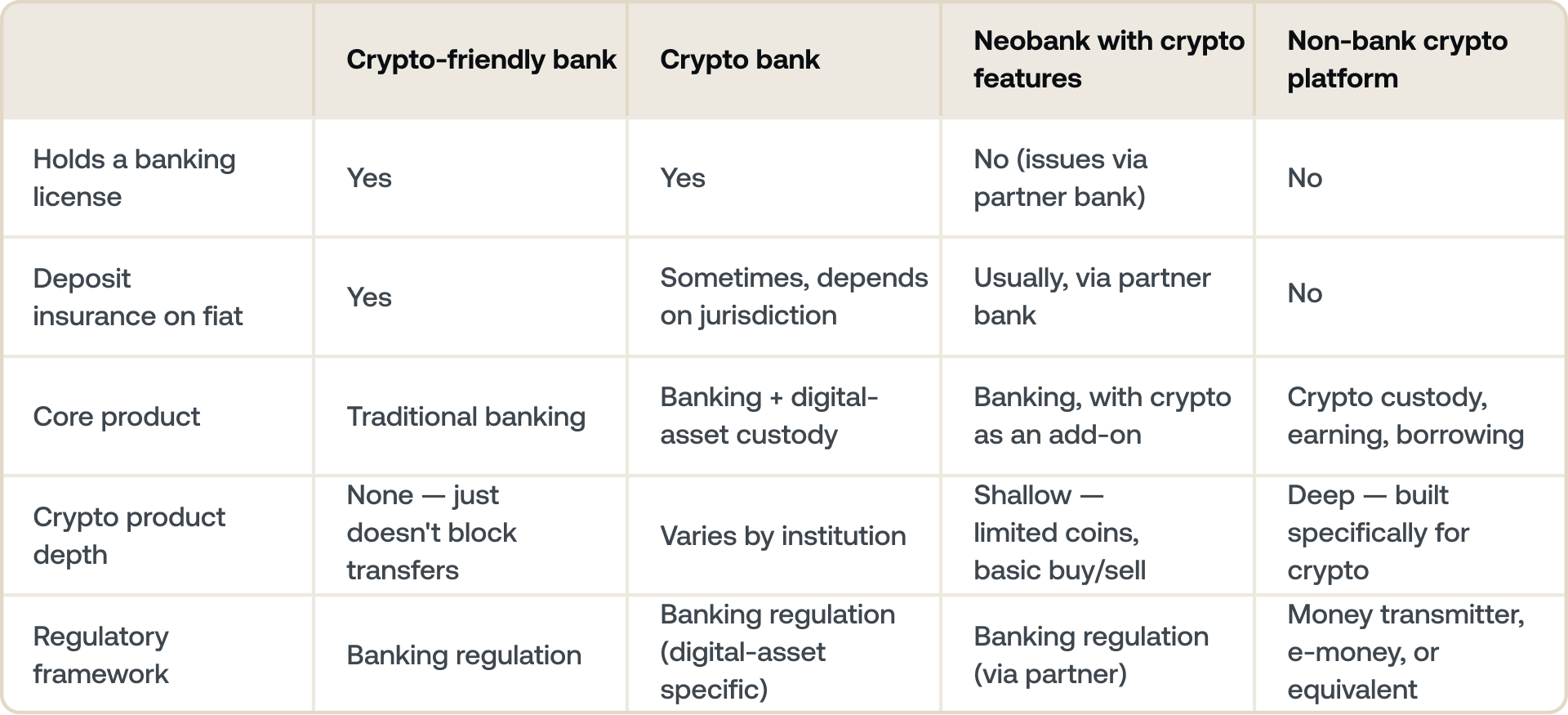
Laid out aspect by aspect, the variations come down to a few questions. Does the corporate maintain a banking license? Is your steadiness coated by deposit insurance coverage? And how does the platform actually secure and custody your crypto? The desk beneath solutions all three.
How to decide on between them
In case you simply want your paycheck to land someplace and infrequently fund a crypto buy with out your financial institution flagging the switch, a crypto-friendly financial institution covers that. Nothing extra wants to vary.
If you'd like your day-to-day banking and a small crypto steadiness in a single app, a neobank with crypto options is an inexpensive center floor — so long as you are snug with the restricted coin choice and better charges that include the comfort.
If crypto is the place you truly need the depth — earning on balances you're not actively trading, unlocking liquidity against holdings without selling them, or buying and selling with extra vary than a neobank's bolt-on function permits — that is the hole crypto platforms like Nexo are constructed to fill.
Is crypto banking protected?
Security relies upon solely on which class you are in, and it is value being direct concerning the gaps.
- Crypto-friendly banks and crypto banks: your fiat steadiness is usually coated by normal deposit insurance coverage — FDIC within the US, or an equal scheme elsewhere — the identical as any checking account. Crypto holdings themselves usually are not FDIC-insured anyplace on this panorama; deposit insurance coverage covers money, not digital property, no matter which sort of establishment is holding them.
- Neobanks with crypto options: the fiat steadiness is often insured by the associate financial institution. The crypto layer typically is not.
- Non-bank crypto platforms: neither your crypto nor your fiat steadiness is roofed by deposit insurance coverage. Safety right here comes from the platform's personal custody infrastructure, audits, and licensing.
Throughout each class, the worth of the crypto itself can transfer sharply, and there is not any assure of return on something you maintain or earn. That is not particular to anybody supplier — it is true of digital property typically, regardless of who's holding them for you.
The underside line
These 4 classes get flattened into “crypto financial institution” consistently. However the variations are concrete: whether or not a banking license exists, whether or not deposit insurance coverage applies, and the way deep the crypto performance truly goes.
Crypto-friendly banks and neobanks resolve a fiat-banking drawback with mild crypto comfort connected. Real crypto banks are licensed establishments that stay uncommon.
Non-bank crypto platforms — Nexo included — are neither, and do not declare to be. They're purpose-built for holding, incomes on, and borrowing in opposition to digital property, working beneath the licenses that truly govern that exercise.
Curious what that appears like in apply? See how earning on crypto and borrowing against your holdings work on a platform constructed particularly for it.
Steadily requested questions
1. Is Nexo a financial institution?
No. Nexo is a non-bank crypto platform. It does not maintain a banking constitution and your steadiness is not coated by deposit insurance coverage schemes just like the FDIC. It operates beneath cash transmitter, e-money, or equal digital-asset licenses relying on the jurisdiction, with infrastructure constructed particularly for crypto custody, incomes, and borrowing.
2. What's the actual distinction between a crypto financial institution and a crypto-friendly financial institution?
A crypto financial institution holds an precise banking constitution and places digital property on the middle of its enterprise. A crypto-friendly financial institution is an atypical licensed financial institution that merely does not block your transfers to crypto exchanges — it does not supply any crypto merchandise itself.
3. Is cryptocurrency banking regulated the identical approach as conventional banking?
It depends upon which class you are in. Crypto-friendly banks and crypto banks fall beneath normal banking regulation. Non-bank crypto platforms function beneath separate digital-asset frameworks — cash transmitter or e-money licenses — which is a distinct regulatory regime, not a lighter one.
4. Are “crypto banking options” the identical factor as this?
Not often. “Crypto banking options” most frequently refers to white-label, business-to-business infrastructure that lets banks or fintechs add crypto capabilities to their very own merchandise. This web page is concerning the private aspect: the way you, as a person, maintain and use crypto day-to-day — whether or not by a financial institution, a neobank, or a platform like Nexo.
5. Which particular banks are thought of crypto-friendly?
This varies by nation and modifications as financial institution insurance policies shift, so we do not preserve a ranked checklist right here. The dependable technique to examine is to ask your financial institution straight whether or not it restricts transfers to crypto exchanges, or to search for banks that explicitly promote crypto-related transfers as supported.
6. What's a digital wealth platform, and the way is it completely different from a financial institution?
A digital wealth platform is a non-bank service constructed round managing and rising what you already maintain in digital property — incomes yield, borrowing in opposition to holdings, and buying and selling, in a single place. It does not maintain a banking constitution and is not an alternative to one; it is a completely different class constructed particularly for crypto, working on custody and compliance infrastructure designed for digital property quite than tailored from conventional banking. Nexo is an instance of this class.