
Cryptocurrency Prices by Coinlib
JAXA's $578 Million MMX Probe Heads For Mars To Acquire Samples From Phobos – EGamers.io – P2E NFT Video games Portal

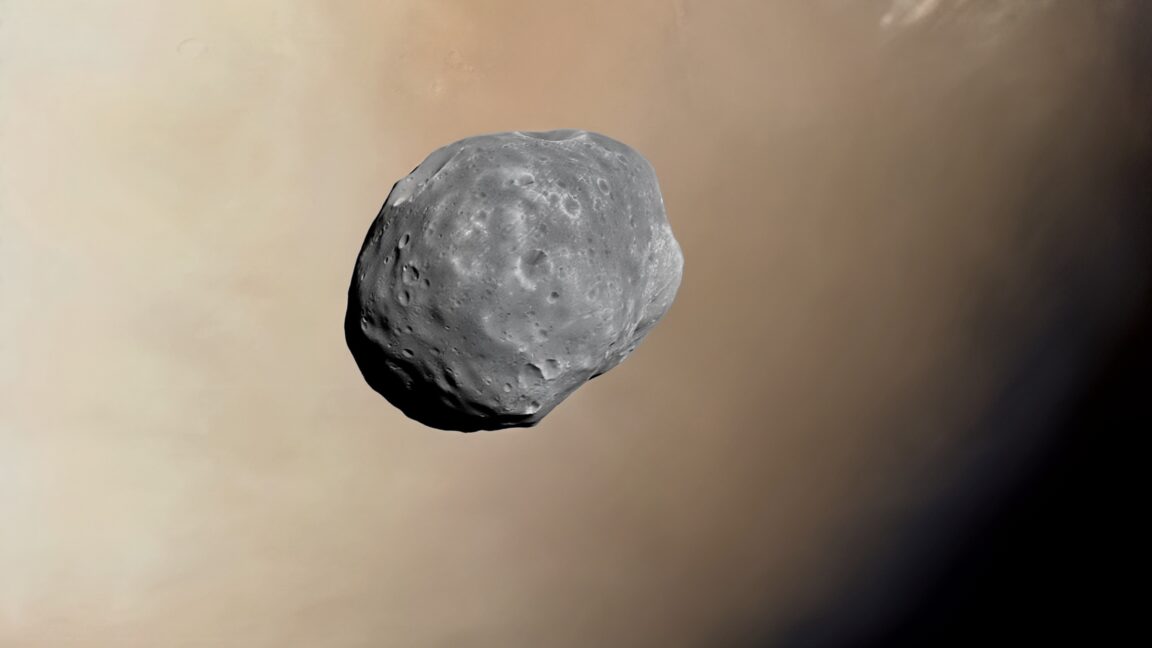
Get our tales first on GoogleAdd egamers.io as a most popular supply and our reporting reveals up larger in your High Tales.Phobos has resisted each try to deliver a chunk of it house. In 1988 the Soviet Union launched two spacecraft towards Mars, every carrying a Phobos lander, and floor groups misplaced contact with each earlier than both completed its mission. Russia tried once more in 2011 with Phobos-Grunt, which failed shortly after launch and by no means left for Mars.Now it’s Japan’s flip. The Martian Moons eXploration mission, or MMX, price $578 million and lifted off from Tanegashima House Middle in southern Japan at 3:41 pm EDT Monday (4:41 am Japan Commonplace Time Tuesday). The launch begins a five-year expedition to land on Mars’ largest moon and return samples to Earth.Hiroshi Yamakawa, president of the Japan Aerospace Exploration Company (JAXA), referred to as the launch a hit. “An extended journey of 5 years has simply began,” he mentioned.[[IMG:1]]A beefed-up H3 for Japan’s heaviest probe yetThe rocket was a 207-foot-tall (63-meter) H3, Japan’s flagship launcher, flying in a configuration that had by no means been used earlier than. It carried 4 strap-on stable rocket boosters, ran its principal engines at full throttle and used an prolonged payload shroud. Japan wanted all of that for the heaviest and most formidable interplanetary mission it has ever tried.MMX weighs almost 9,900 kilos (4.5 metric tons), and propellant makes up two-thirds of that. The H3’s higher stage pushed the probe previous 24,000 mph, sufficient pace to flee Earth’s gravity and begin the 10-month journey to Mars. Separation from the rocket got here roughly 71 minutes after liftoff.Early operations went easily. Quickly after separation the spacecraft made contact with floor controllers, deployed its photo voltaic panels and settled right into a “very secure situation,” in accordance with Yasuhiro Kawakatsu, JAXA’s mission supervisor for the mission. “Thus far, so good.”[[IMG:2]]Japan tells NASA and Europe it’s the safer betJAXA has returned samples from deep area earlier than, although by no means from Mars. Hayabusa and Hayabusa 2 had been the primary two spacecraft on the planet to deliver pristine asteroid specimens again to Earth. Kawakatsu mentioned these missions turned deep-space pattern return right into a “speciality” for Japan’s area program.NASA and European area businesses contributed to MMX due to that historical past, and Kawakatsu didn’t soften the explanation.“We have now a confirmed observe report of success in these areas,” Kawakatsu mentioned. “Due to this, I consider they're collaborating with the understanding that in the event that they need to conduct celestial physique pattern returns, becoming a member of a mission led by Japan is extra sure to succeed than the US or Europe launching their very own missions.”Yoshihiro Seki, Japan’s science minister, described the mission as a world first. “The MMX [mission] we launched right this moment is a difficult mission aiming for the world’s first pattern return from the Martian moons,” Seki mentioned. “We hope that the outcomes obtained by way of this mission will contribute to the event of our nation’s area science and exploration know-how.”Captured asteroid or crash particles?Of Mars’ two moons, Phobos is the larger one. It’s a lumpy, potato-shaped physique with a mean diameter of 14 miles (22 kilometers) and roughly the floor space of Houston. Its origin continues to be unknown.“One of the crucial intriguing questions on Phobos and Deimos is just why these two little moons are there within the first place,” mentioned Tom Statler, NASA's lead scientist for photo voltaic system small our bodies. “In some methods, they resemble asteroids from the outer a part of the asteroid belt, in order that they might be asteroids that had been captured by Mars’s gravity. However there are different traces of proof pointing to those moons being remnants of an enormous influence early in Mars's historical past.”One concept is that Phobos is an asteroid that Mars pulled into orbit billions of years in the past. Checking that concept is amongst MMX’s science targets, and Statler mentioned samples in a lab are what's going to reply it.“By going to the Martian moons, finding out them up shut, and bringing samples again to Earth, we’ll be capable to decide whether or not Phobos materials is extra in line with an asteroid composition or with particles created by a collision involving Mars,” Statler mentioned.The mission might additionally return one thing further. Phobos sits roughly 40 instances nearer to Mars than our Moon does to Earth, so materials from the pink planet might have landed on Phobos after it fashioned or was captured, and MMX might choose a few of it up. That will give scientists an early have a look at Mars floor materials. Returning samples from Mars itself is a far tougher job than returning them from Phobos.[[IMG:3]]Circling a moon too small to orbitMMX reaches Mars subsequent August and can keep within the neighborhood for about three years, making repeated shut passes of Phobos and its smaller companion, Deimos.After arrival the probe jettisons its propulsion module, which is lifeless weight as soon as it has burned all its gas to enter Mars orbit. The remaining principal spacecraft and its four-legged touchdown gear, collectively referred to as the exploration module, then strikes nearer to Phobos.A standard orbit across the moon isn’t potential as a result of Phobos’ gravity is simply too weak and Mars pulls too laborious. As an alternative MMX will use a quasi-satellite orbit, which retains it certain to Mars whereas letting it maneuver round Phobos.[[IMG:4]]A shoebox-sized rover goes down firstReconnaissance ends in late 2028 or early 2029. At that time the mothership releases a small four-wheeled rover referred to as Idefix onto Phobos. The French and German area businesses constructed it.Idefix is about as massive as a big shoebox. It's going to try to drive throughout Phobos for as much as 100 days, dealing with tough terrain and gravity under one-thousandth of Earth’s.Two landings, two sampling methodsLater in 2029 comes the primary occasion: the spacecraft will attempt as much as two landings on Phobos. As a result of the moon’s gravity subject is weak and uneven, there’s an actual threat of the probe tipping over or bouncing again into area, so the touchdown gear is designed to take in the power of every landing.MMX will spend a number of hours on the floor throughout every touchdown and collect materials in two unbiased methods. A coring drill on the finish of its robotic arm will extract a cigar-shaped specimen. A pneumatic sampler from NASA, mounted on one touchdown leg, will fireplace a cartridge of high-pressure nitrogen gasoline to blow bits of Phobos into a set canister.Scientists anticipate a mixed haul of at the very least 10 grams, or one-third of an oz. As soon as again in area, MMX will shed its touchdown gear and fireplace its engines in 2030 for the journey to Earth. In 2031 it should steer a pattern return capsule towards a distant touchdown zone in South Australia.[[IMG:5]]Laboratories in Japan will analyze the samples. In return for NASA’s {hardware}, US researchers will obtain 15 % of the Phobos materials. NASA provided one of many samplers plus a gamma-ray and neutron spectrometer that measures the fundamental make-up of the Martian moons.Kawakatsu mentioned what MMX learns about Phobos might assist future planners choose whether or not the moon is appropriate for human exploration, probably as a stopover between Earth and Mars.[[IMG:6]]Many years of finding out them from a distanceScientists have solely ever studied these moons from far-off. MMX is designed to repair that.“Mainly, these objects look extra like primitive asteroids than the rest, however the information is coming from distant sensing from far-off,” mentioned Patrick Michel, a French asteroid scientist who co-leads the Idefix rover mission. “That can't actually inform us precisely what are the properties, as we are able to do with a pattern return within the lab.”“The purpose of the mission is successfully to disclose the origin of the Martian moons,” Michel mentioned. “If we perceive the origin, that may inform us one thing in regards to the early phases of the Photo voltaic System.”
Source link