Cryptocurrency Prices by Coinlib
ELLIPAL vs Trezor 2026 | Air-Gapped vs USB Comparability


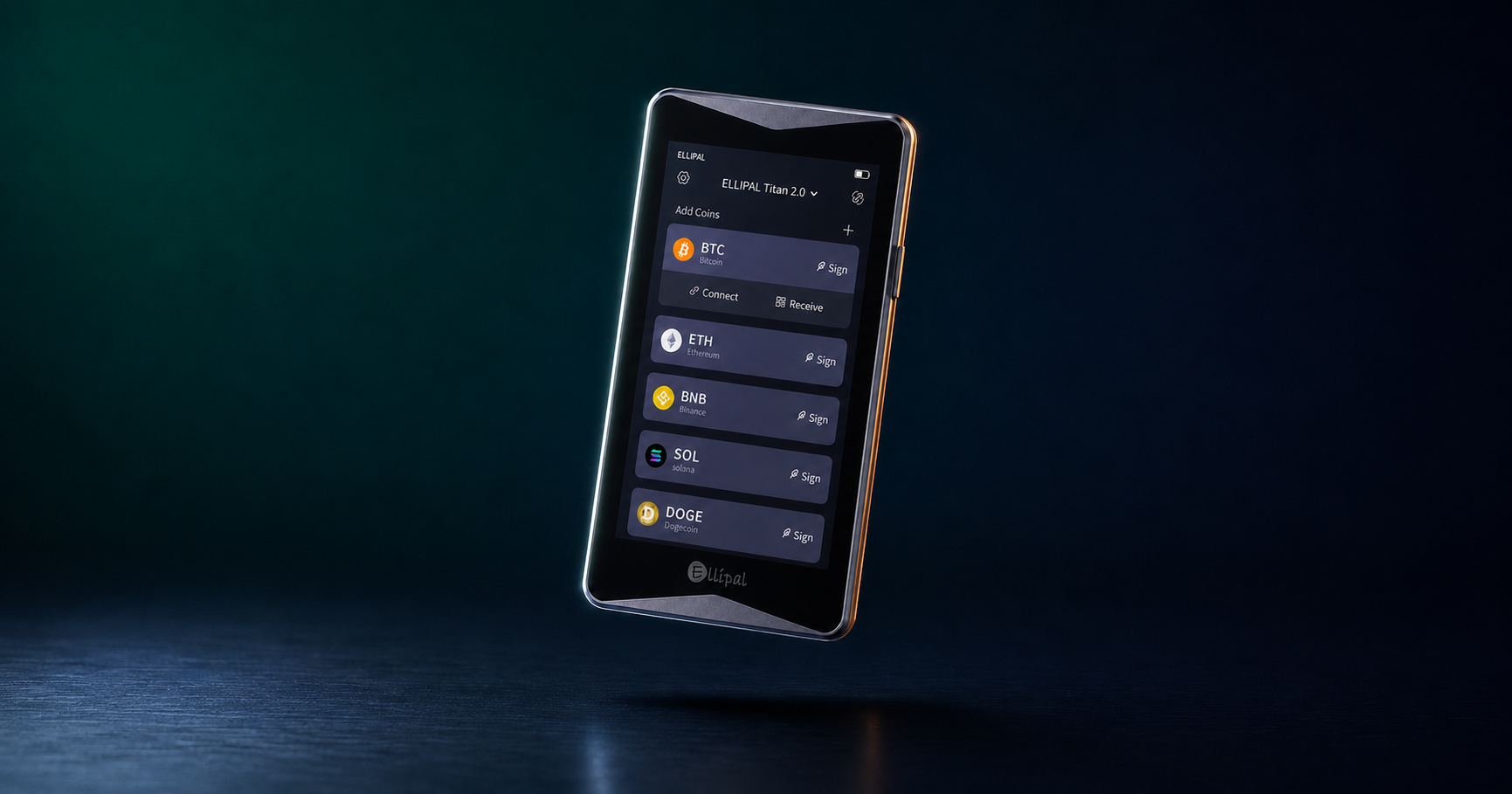
Most important Takeaway: ELLIPAL Titan 2.0 and Trezor are each {hardware} chilly wallets that retailer personal keys offline and signal transactions on the machine, with safe components defending the keys in each circumstances. The place they diverge is on three design selections: connection methodology (Titan indicators by QR code solely, Trezor indicators over USB), firmware transparency (Trezor is open supply, ELLIPAL is closed supply), and kind issue (Titan is phone-sized with a 4-inch touchscreen, Trezor is keychain-sized with smaller shows). Each comply with the BIP39 normal, so a restoration phrase from one restores on the opposite. The correct selection will depend on which of these three trade-offs issues most to your use case.
Fast reference
| Time period | What it means |
|---|---|
| Air-gapped | A {hardware} pockets with no web, Bluetooth, USB information, or NFC connection, which communicates solely by QR code |
| USB {hardware} pockets | A pockets that indicators transactions over a bodily cable to a pc or cellphone |
| Open-source firmware | Pockets firmware whose code is publicly auditable, so impartial researchers can confirm conduct |
| Safe component | A licensed chip contained in the machine that shops personal keys and performs signing |
| BIP39 | The industry-standard restoration phrase format, so the identical seed works on any BIP39-compatible pockets |
| Companion app | The desktop or cellular utility that builds transactions and sends them to the pockets for signing |
ELLIPAL Titan 2.0 vs Trezor at a look
| Dimension | ELLIPAL Titan 2.0 | Trezor |
|---|---|---|
| Connection | QR code solely (air-gapped) | USB cable to pc or cellphone (with adapter) |
| On-device display screen | 4-inch shade touchscreen | Varies: monochrome display screen on Trezor One, shade touchscreen on Mannequin T and Protected 5, smaller show on Protected 3 |
| Firmware | Closed supply, signed updates by way of microSD | Open supply, with public code repositories and impartial audits |
| Safe component | CC EAL5+ throughout the product line | None on the unique Trezor One; Optiga Belief M (CC EAL6+) on Protected 3 and Protected 5 |
| Anti-tamper design | Full-metal sealed casing, designed to wipe saved keys if the enclosure is pressured open | Plastic casing with tamper-evident seal |
| Companion app | ELLIPAL App, mobile-first, targeted on signing and broadcasting | Trezor Suite, out there on desktop and cellular, with broader portfolio and trade options |
| Type issue | Cellphone-sized handheld, single machine | Keychain-sized, designed to clip to a keyring or carry in a pocket |
| Restoration normal | BIP39 / BIP44 | BIP39 / BIP44; Shamir Backup (SLIP-39) supported on Mannequin T, Protected 5, and choose fashions |
| Monitor report | In the marketplace since 2018, with greater than 1 million customers in 140+ international locations | The longest-running {hardware} pockets model, since 2014, with a big world consumer base |
Three architectural selections that diverge
ELLIPAL Titan 2.0 and Trezor share the fundamental premise {that a} {hardware} pockets ought to maintain personal keys off any internet-connected machine, with signing taking place contained in the pockets quite than on a cellphone or pc. From that shared place to begin, the 2 manufacturers have answered three design questions otherwise.
Query 1: How ought to the pockets talk with the surface world?
Trezor makes use of USB. A cable plugs into the machine, and transaction information flows backwards and forwards between the pockets and a pc or cellphone. The safe component on Protected 3 and Protected 5 retains the personal key contained in the chip throughout signing, and the cable itself is a transport channel quite than a key-extraction path.
ELLIPAL Titan 2.0 makes use of QR codes solely. The machine has no USB information port, no Bluetooth radio, no Wi-Fi chip, and no NFC antenna. Communication with the ELLIPAL App occurs by the machine's digicam scanning a QR code from the cellphone, and the cellphone scanning a signed QR code again from the machine. Nothing crossing between the 2 units is greater than mild.
The sensible distinction is what sort of assault every structure removes. USB removes wi-fi assault paths however retains a bodily information path between the pockets and a linked pc. Air-gapped QR removes each, since no information connection exists in any respect. For long-term holdings, the air-gapped path is the structurally extra remoted choice. For desktop-centered crypto use, USB is operationally smoother.
Query 2: Ought to the firmware be open supply?
Trezor publishes its firmware supply code and {hardware} schematics. Anybody can learn what the pockets does, audit it, and suggest adjustments. For holders who deal with code transparency as a safety property, that is essentially the most seen single distinction between Trezor and most opponents, ELLIPAL included.
ELLIPAL's firmware is closed supply, with updates delivered by way of signed microSD photos. The argument for closed-source firmware is that public code can also be seen to attackers planning an exploit, whereas signed updates from a trusted supply nonetheless let the producer push safety patches. The argument towards is that closed code can't be independently verified by exterior researchers.
Neither stance is universally appropriate, and each have reliable customers. If open-source firmware is a non-negotiable for you, Trezor suits that requirement extra straight than ELLIPAL. If you happen to weigh different components extra closely, the open-source distinction is probably not decisive by itself.
Query 3: Keychain or vault?
Trezor is constructed round portability. Units are keychain-sized, simple to hold, and meant for use at the side of a linked pc. Even the bigger touchscreen fashions keep within the small-device class.
ELLIPAL Titan 2.0 takes the alternative design selection. The machine is phone-sized, with a 4-inch touchscreen giant sufficient to show a full transaction with out scrolling. It's constructed across the concept of a vault that lives someplace particular, taken out solely when you'll want to signal, with deliberate evaluate of every transaction on a display screen giant sufficient to really learn.
The shape issue displays the use case every model optimizes for. A keychain Trezor suits right into a desktop crypto workflow the place the pockets plugs in for every session and goes again right into a pocket. A Titan 2.0 suits a long-term storage workflow the place the pockets stays in a single place and will get dealt with for high-stakes transactions.
Connection strategies in contrast
The connection distinction deserves a better look, because it shapes the risk mannequin greater than some other single property.
USB carries transaction information by a bodily cable. The Trezor safe component handles the delicate operations, and the personal key doesn't go away the chip throughout regular use. The cable is the floor, because it creates a direct information path between the pockets and no matter pc it's plugged into. If that pc is compromised, the pockets is speaking with a hostile atmosphere, though the safe component nonetheless requires the consumer to verify transactions on the machine display screen earlier than signing.
QR-only signing has neither cable nor radio. The {hardware} pockets's digicam reads a QR code out of your cellphone, the machine indicators internally, and the signed transaction returns to the cellphone as one other QR code. Your cellphone broadcasts the signed transaction to the blockchain community. Nothing on this move makes use of a cable, a wi-fi radio, or contactless information, so there isn't any distant community path to the machine itself.
Neither methodology is damaged in on a regular basis use. The purpose of evaluating them is that they place the {hardware} pockets in structurally completely different positions relative to the surface world. For deeper protection of how air-gapped signing works mechanically, see our explainer on air-gapped signing.
Companion apps: the place the philosophies present up
Trezor Suite is the desktop and cellular utility that pairs with Trezor units. It consists of portfolio administration, trade integration, staking, and DeFi entry. The companion is full-featured and treats the pockets as one element in a broader crypto setup.
The ELLIPAL App is mobile-first and deliberately narrower. Its main jobs are constructing transactions, displaying them as QR codes for Titan 2.0 to scan, and broadcasting the signed transactions again to the community. Purchase and swap options exist however route by clearly attributed third-party providers. The app doesn't attempt to be a portfolio tracker or a DeFi gateway.
Neither strategy is universally appropriate. A holder who desires one built-in app that handles staking, swaps, and trade flows alongside signing will discover Trezor Suite a better match. A holder who desires the signing machine and its app to do one factor very nicely will discover ELLIPAL's strategy extra aligned with that choice.
Restoration and portability: each comply with BIP39
One level that always will get misplaced in brand-versus-brand comparisons: each Trezor and ELLIPAL comply with the BIP39 normal. A restoration phrase generated on one model restores on the opposite, or on some other BIP39-compatible pockets. This portability is a property of the usual itself, since any BIP39 pockets derives the identical keys from the identical phrases.
Trezor moreover helps Shamir Backup (SLIP-39) on Mannequin T, Protected 5, and choose fashions, which helps you to cut up a restoration secret into a number of shares with a configurable threshold for reconstruction. ELLIPAL doesn't assist SLIP-39 on the time of writing. For holders particularly occupied with Shamir-style backup splitting on the machine, Trezor is the choice that has it inbuilt.
For many BIP39 use, together with importing a seed phrase from one model to the opposite, the usual works the identical on either side. You'll be able to arrange on Trezor at this time and transfer to ELLIPAL later, or the reverse, and the seed phrase you wrote down nonetheless controls the identical accounts.
Which one suits which situation?
- “I would like open-source firmware that impartial researchers can audit.” Trezor suits this requirement straight, for the reason that total firmware codebase is publicly auditable.
- “I would like long-term vault storage on a tool with no wi-fi or wired information path.” ELLIPAL Titan 2.0 suits, since air-gapped QR signing removes each assault surfaces.
- “I desire a small machine I can keep on a keychain.” Trezor is constructed round portability, with keychain-sized fashions throughout the product line.
- “I would like a big display screen to confirm the total transaction earlier than signing.” ELLIPAL Titan 2.0's 4-inch touchscreen reveals the whole transaction together with the total vacation spot deal with, with out requiring scrolling.
- “I would like Shamir Backup (SLIP-39) for splitting my restoration secret.” Trezor Mannequin T and Protected 5 assist Shamir Backup straight; ELLIPAL doesn't.
- “I desire a companion app targeted on signing solely, not a full portfolio platform.” The ELLIPAL App is constructed across the narrower scope.
- “I desire a companion app with built-in portfolio, staking, and DeFi options.” Trezor Suite covers the broader function floor.
- “I would like each long-term chilly storage and a card I faucet for day by day use, in a single ecosystem.” ELLIPAL covers each, with Titan 2.0 because the vault and the X Card because the daily-carry NFC card pockets.
FAQ
Is ELLIPAL Titan 2.0 or Trezor safer?
Neither is universally safer. Each use licensed safe components (Titan 2.0 with CC EAL5+; Trezor Protected 3 and Protected 5 with CC EAL6+), each comply with the BIP39 normal, and each maintain personal keys contained in the machine throughout signing. The safety variations price evaluating are connection structure (air-gapped vs USB), firmware transparency (Trezor open supply benefit), and anti-tamper development (Titan full-metal sealed). Which mixture is “safer” will depend on the particular threats you're defending towards.
Does the unique Trezor One have a safe component?
No. The unique Trezor One launched in 2014 makes use of an STM32 microcontroller quite than a devoted safe component. Trezor's newer Protected 3 and Protected 5 added the Optiga Belief M safe component (CC EAL6+). If an authorized safe component issues to you, take a look at the Trezor Protected 3 or Protected 5 quite than the unique Trezor One.
Can I transfer my Trezor restoration phrase to ELLIPAL?
Sure. Each wallets comply with the BIP39 normal, so the 12 or 24 phrase phrase from a Trezor machine restores on ELLIPAL Titan 2.0 or the X Card. The identical is true in reverse. Your accounts and addresses are derived from the seed itself, not from the model. In case your Trezor makes use of Shamir Backup (SLIP-39), you would want to transform again to a BIP39 phrase earlier than importing to ELLIPAL.
What occurs if Trezor or ELLIPAL goes out of enterprise?
Your crypto stays on the blockchain regardless. As a result of each use BIP39, your restoration phrase restores on any BIP39-compatible pockets from any model. The pockets ecosystem you select isn't a everlasting dedication, since the usual is what makes the restoration transportable, not the corporate.
How does open-source firmware truly have an effect on safety?
Open-source firmware lets impartial researchers learn the code that controls your pockets, which surfaces points that closed code wouldn't. The trade-off is that the identical code can also be seen to attackers planning an exploit. In follow, most safety researchers take into account the auditability achieve to outweigh the visibility value for safety-critical units like {hardware} wallets. Whether or not this single issue decides your selection will depend on how a lot weight you place on it relative to different design questions.
Which is less complicated to arrange?
Each take 5 to fifteen minutes for first-time setup. ELLIPAL Titan 2.0's setup occurs solely on the 4-inch touchscreen of the machine itself. Trezor's setup occurs by Trezor Suite on a desktop or cellular machine, mixed with button presses or touchscreen affirmation on the machine. Which feels simpler will depend on whether or not you like touchscreen entry on a bigger display screen or step-by-step steerage by a desktop app.
Can I exploit ELLIPAL and Trezor collectively?
Sure. Many holders use a number of {hardware} wallets to separate accounts by function, resembling a long-term vault on one machine and energetic holdings on one other. As a result of each comply with BIP39, the seed phrases are transportable, and accounts on every pockets are independently managed. For transferring an present seed phrase between the 2, see our guide on importing a seed phrase into a hardware wallet.
Does Trezor work with cellphones?
Sure, with caveats. Trezor Suite Lite for cellular enables you to view balances and use the pockets on iOS and Android, however precise signing sometimes requires a USB connection. On telephones, this implies utilizing a USB-C to USB-A adapter, which provides friction in comparison with wallets designed for cellular from the beginning. ELLIPAL Titan 2.0 was constructed mobile-first round QR scanning, which removes the cable adapter requirement.
The belief layer
- Commonplace: BIP39/44 on each, recoverable on any suitable pockets from any model
- ELLIPAL observe report: in the marketplace since 2018, with greater than 1 million customers in 140+ international locations, and 0 breaches throughout the air-gapped product line
- ELLIPAL Titan 2.0 specifics: CC EAL5+ safe component, full-metal sealed anti-tamper casing, 4-inch touchscreen for transaction evaluate
- Trezor observe report: the longest-running {hardware} pockets model, in the marketplace since 2014, with a big world consumer base and a considerable open-source neighborhood
- Trezor specifics: open-source firmware throughout the product line; CC EAL6+ safe component on Protected 3 and Protected 5; SLIP-39 Shamir Backup on Mannequin T, Protected 5, and choose fashions
- Coin assist: each assist 1000's of tokens throughout main blockchains, with particular chain assist various by mannequin and model
- Unbiased critiques: Coin Bureau, 99Bitcoins, CryptoNews cowl each manufacturers
The selection between ELLIPAL Titan 2.0 and Trezor is one in all match quite than rating. Each serve {hardware} pockets customers nicely within the use circumstances they had been constructed for, and the seed phrase you again up works on both facet of the comparability if you happen to change your thoughts later. Match the structure and firmware posture to what you truly need, and the correct machine for you tends to be apparent.
Personal it. Then use it.
Safety observe: No self-custody setup removes each threat. Each air-gapped and USB {hardware} wallets shut important classes of distant assault, however they don't eradicate bodily, supply-chain, firmware, social-engineering, or user-error dangers. Purchase from an official supply, retailer your restoration phrase on a sturdy offline backup stored individually from the machine, don't share or digitally enter it, and confirm each transaction on the machine display screen earlier than approving. This text is common academic details about {hardware} pockets structure and is predicated on publicly out there product info for ELLIPAL and Trezor as of 2026; product variants could differ. It isn't monetary, funding, or custodial recommendation.